
A sports subscription should not remain active simply because the payment renews automatically. Once the main season ends, the value of the service changes. Live fixtures may disappear, while replays, documentaries, draft coverage, transfer analysis, classic games, and preseason programming become the main reasons to keep paying.
The right decision therefore depends less on the size of the platform’s catalog and more on the amount of content you actually use. A service can contain thousands of hours of programming and still provide poor value if you open it only once or twice a month.
A practical review should cover six areas: viewing time, archive depth, offseason coverage, exclusive programming, additional features, and subscription terms.

AsMeasure the Cost Against Your Actual Viewing Time
Begin with the number of hours you have watched during the previous 30 to 60 days. Do not include programs saved to a watchlist or content you intend to watch later. Only count completed viewing sessions.
A useful calculation is:
Monthly subscription fee ÷ actual viewing hours = cost per hour watched
For example, if a subscription costs $20 per month and you watch ten hours of replays, documentaries, and analysis, your effective cost is $2 per hour. If you use the platform for only two hours, that cost rises to $10 per hour.
This does not mean that every subscriber must reach a fixed hourly target. Ten hours a month may represent good value for one person but not for another. Exclusive access, household use, convenience, and the difficulty of finding legal alternatives can all affect the result.
Still, viewing time provides a more reliable basis than vague intentions. A fan who watches several archived games every week may reasonably keep the subscription. Someone who opens the app only for one short documentary may be better off canceling and returning closer to the new season.
The calculation becomes even more useful when comparing monthly and annual plans. A discounted annual subscription can appear cheaper, but it may cost more overall if the service remains unused for several months.
Look Beyond the Number of Available Replays
Not every replay library offers the same level of access. Some platforms provide only short highlights, while others include full broadcasts, condensed versions, alternate commentary, tactical camera angles, and older seasons.
NFL+ Premium, for example, advertises full-game replays, condensed games, and All-22 coaches film. It also includes NFL Films programming and live out-of-market preseason games, although geographic restrictions may apply. The service is therefore more useful outside the regular season for viewers who study formations, revisit complete games, or follow preseason activity rather than watching only short clips.
NBA League Pass provides live and on-demand games, condensed formats, selected classic matchups, and a full-game archive extending back to the 2012–2013 season. Depending on the region and device, it may also include multiple broadcast feeds, real-time statistics, NBA TV, and Multiview.
These differences matter because the term “game archive” can describe very different products. Before renewing, determine whether the service contains:
- Full matches from the previous season
- Condensed versions that preserve the main action
- Tactical or alternate camera feeds
- Classic games from earlier seasons
- Team-specific broadcasts or commentary
- Interviews, press conferences, and postgame analysis
A large archive is valuable only when it matches how you watch. Someone who studies tactics may benefit from coaches film and full replays. A casual fan who watches only five-minute highlights can probably find enough material through free official channels.
Availability may also differ by country, device, and broadcasting agreement. Do not assume that every feature shown on a United States subscription page will be included in another market.
Account for Drafts, Transfers, Training Camps, and Preseason Coverage
The end of competitive matches does not always mean the end of meaningful sports coverage. For many leagues, the offseason includes the draft, free agency, player trades, contract negotiations, training camps, roster changes, and preseason games.
This period can be as important as the regular season for supporters who closely follow team building. The value comes from depth rather than speed. Basic transfer announcements and draft results usually appear free on league websites, team accounts, YouTube, and social media. A paid service becomes more useful when it adds detailed scouting reports, player data, tactical projections, expert commentary, team-specific reporting, and extended interviews.
For example, an announcement that a player has joined a new team is widely available. What may justify a subscription is a longer analysis explaining how the player fits the roster, how the move affects salary limits, which tactical role may change, and what alternatives the team considered.
The same principle applies to preseason programming. A short free highlight may show the final score, while a paid replay can reveal lineup experiments, rookie performance, coaching adjustments, and positional competition.
Before retaining the plan, identify which offseason events you genuinely follow. A basketball fan may care about free agency and summer competition. An American football subscriber may focus on the draft, training camp, and preseason. A football supporter may place more value on transfers, friendly matches, and tactical previews.
If the service’s offseason schedule does not align with those interests, the subscription may not deserve another monthly payment.
Separate Exclusive Material From Free Alternatives
The presence of original programming does not automatically make a service valuable. The important question is whether you actually watch it and whether a similar experience is available elsewhere.
Official team channels, league websites, YouTube, podcasts, sports news outlets, and social platforms often provide free access to highlights, press conferences, interviews, transfer updates, and short analysis clips. These sources may be sufficient for fans who mainly want current information.
Paid platforms become harder to replace when they offer complete documentaries, long-form interviews, original series, extensive archives, or exclusive live events. ESPN’s current subscription offerings include ESPN Originals, 30 for 30 films, E60 programming, studio shows, and a large range of live sports, although the exact content depends on the selected plan and market.
To evaluate exclusivity properly, review your viewing history and divide the content into three groups:
- Material available only through the subscription
- Similar content available free but with less depth or convenience
- Content that can be replaced easily without losing anything important
Only the first two groups contribute meaningful subscription value.
Suppose you watched four documentaries, three complete game replays, and several exclusive interviews during the past month. Keeping the plan may be reasonable. If your history contains only short highlights and general sports news, free official sources may already cover most of your needs.
Avoid paying for exclusivity in theory. A documentary library creates no practical value when you never open it.
Count Only the Additional Features You Actually Use
Sports services often advertise premium tools alongside their video catalog. These may include Multiview, advanced statistics, alternate broadcasts, team radio, downloadable games, ad-free highlights, 24-hour channels, and tactical camera feeds.
NBA League Pass, for instance, lists live statistics overlays, several broadcast feeds, Multiview for up to four games, full archives, condensed formats, NBA TV, and offline downloads for Premium subscribers.
NFL+ Premium includes full, condensed, and All-22 replays, while other NFL+ features include live game audio, NFL Network, NFL Films, preseason access, and ad-free highlights.
MLB.TV currently promotes live and on-demand out-of-market games, MLB Network access in the United States, Minor League Baseball content, MLB Big Inning, and live audio for every MLB team. Its MLB+ offering also includes Gameday 3D and selected out-of-market games. Geographic blackouts and national exclusivity restrictions still apply.
The mistake is treating every listed feature as part of the value you receive. A feature counts only when it affects your actual experience.
For example, Multiview is useful during periods with several simultaneous games but may provide little benefit in the offseason. Offline downloads matter to frequent travelers but not to someone who watches only at home. Advanced statistics may justify a premium tier for analytical viewers, while casual fans may never activate them.
Review the feature list and mark each item as used regularly, used occasionally, or never used. Features in the final category should not influence the renewal decision.

Review Cancellation Timing and Automatic Renewal Terms
The final step is financial rather than editorial. Check the billing date, renewal type, cancellation route, and the difference between monthly, seasonal, annual, and bundled plans.
Automatic renewal creates the greatest risk because a subscriber may be charged before realizing that the service is no longer needed.
NFL states that NFL+ and NFL+ Premium renew automatically until canceled. Subscribers who purchased directly can manage cancellation through their NFL account, while app-store purchases must be canceled through the relevant store. The renewal date is also shown in the subscription management area.
NBA League Pass also allows subscribers to opt out of automatic renewal. The cancellation procedure depends on where the subscription was purchased, including NBA.com, Apple, Google Play, Roku, Amazon, or Samsung.
MLB.TV states that seasonal subscriptions renew annually at the then-current full-season price unless canceled before the next billing period. Its current plan page also identifies the expected renewal date and notes that blackout restrictions can depend on physical location.
ESPN subscriptions can be canceled through the account’s subscription controls, with cancellation taking effect at the end of the billing cycle. ESPN also states that partially used billing periods are generally not refunded or credited.
Do not assume that every platform supports pausing. ESPN’s official support information, for example, says that certain ESPN and MLB.TV plans cannot be paused, although automatic renewal can be canceled while access continues until the paid period ends.
Before taking action, record:
- The next billing date
- Whether the plan renews monthly, seasonally, or annually
- The price charged after any promotion ends
- Whether cancellation takes effect immediately or after the current period
- Whether unused time is refundable
- Whether the subscription was purchased directly or through an app store
- Whether a pause option actually exists
If you expect almost no use for two or three months, canceling and subscribing again shortly before the season may cost less. Keeping the plan may still be preferable when the annual discount exceeds the inactive-month savings, the archive remains heavily used, or other household members continue watching.
A Practical Offseason Decision
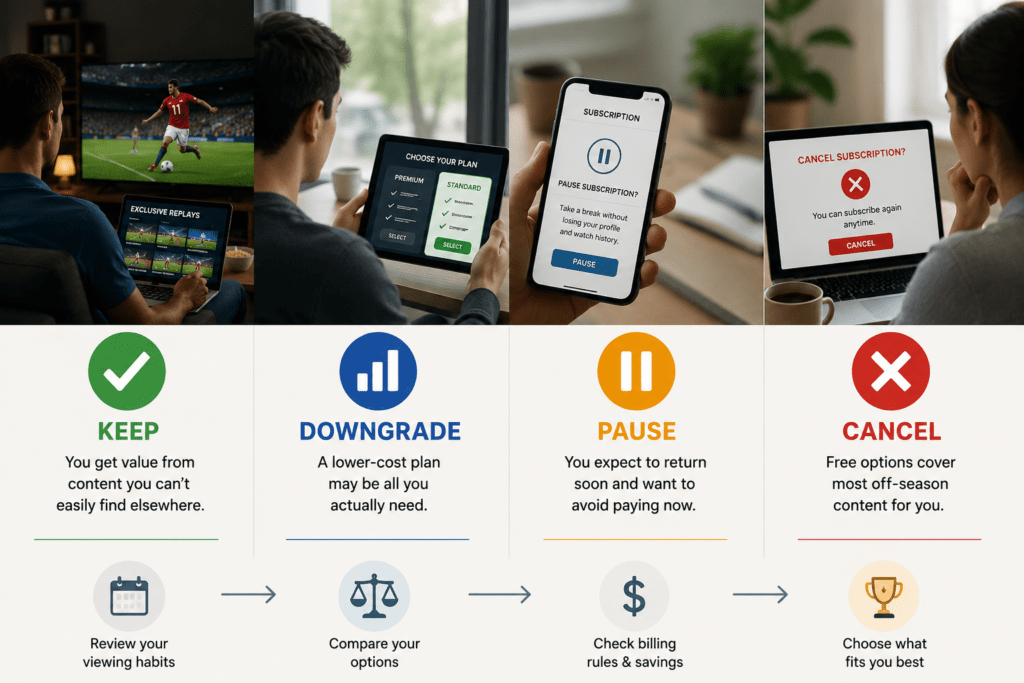
The subscription is probably worth keeping when you use it every week, rely on complete archives, follow draft or transfer analysis, and regularly watch material unavailable through free sources.
A downgrade may be more suitable when you still value the platform but rarely use its premium tools. Cancellation is usually the stronger option when viewing has fallen to one or two hours a month, most content can be replaced for free, and several inactive months remain before the next important event.
The decision should come from recent behavior rather than possible future interest. Review the previous 30 to 60 days, calculate the effective hourly cost, identify the programs that cannot be replaced, and check the next renewal date.
Offseason content creates value only when it is watched. A large catalog, advanced features, and exclusive programs do not justify a subscription by themselves. What matters is whether those benefits remain part of your real sports-viewing routine.